
Yes. A chiropractor can ease desk-related back pain by correcting spinal alignment, releasing tight muscles from prolonged sitting, and coaching you on posture and workstation setup so the pain doesn’t keep returning.
You sit down at your desk at 9am feeling perfectly fine. By 3pm, your lower back is aching, your neck won’t turn properly, and your shoulders have crept up somewhere near your ears.
Sound familiar? If you are a desk worker in Applecross or the greater Perth metro, you have probably lived this exact cycle hundreds of times.
You are far from alone. Nearly 3 million Australians were living with long-term back problems in 2024, and that number is projected to climb past 3.2 million by 2033.
The cost to productivity and quality of life is staggering, yet most people shrug it off as “just part of having a desk job.”
It does not have to be. This article explains why sitting causes so much pain, how a chiropractor for office workers can directly address desk posture problems, and what you can start doing today to feel better.
Why Does Sitting at a Desk All Day Hurt Your Back So Much?
Your body was built to move, not to hold the same position for eight hours straight. When you sit for long stretches, your hip flexors tighten, your glutes stop firing, and your lower back gradually loses its natural inward curve.
Without that curve, the weight of your upper body presses down unevenly on your spinal discs, and the small stabilising muscles along your spine have to work overtime to keep you upright.
Over weeks and months, this leads to stiffness, aching, and sometimes sharp pain that doesn’t go away when you stand up.
This is not a minor issue. According to Safe Work Australia, musculoskeletal disorders are the leading cause of workers’ compensation claims in the country, accounting for more than half of all serious claims.
Body stressing, which includes the kind of repetitive postural strain office workers experience daily, is the single most common cause of those injuries.
Perth office workers, including those in Applecross, Mount Pleasant, and Ardross, face the same risks as desk workers anywhere in Australia. The difference is whether you do something about it before the discomfort becomes a bigger problem.
Tech Neck and Forward Head Posture: The Hidden Culprits
Tech neck is a postural condition where your head shifts forward from staring at screens for too long, adding up to 27 kilograms of extra force on your cervical spine.
That is roughly the weight of a small child hanging off the back of your neck all day.
Here is how it sneaks up on you:
- It builds gradually: You lean in slightly to read an email. You tilt your head down to check your phone. Over weeks and months, your muscles adapt to this forward position and start treating it as your new normal.
- You won’t feel it right away: Most people have no idea their head posture has shifted until the pain shows up, usually as a dull ache between the shoulder blades, tightness across the tops of the shoulders, or stiffness in the neck by the end of the workday.
- It rarely stays in one spot: What starts as neck tension often spreads into headaches, upper back soreness, and restricted shoulder movement. The longer it goes uncorrected, the harder your body has to compensate.
If your neck and shoulders feel tight after a day at the desk, forward head posture is almost certainly part of the picture.
Can a Chiropractor Actually Help With Posture Problems?

Yes. Chiropractors are trained to assess spinal alignment and identify the postural imbalances that develop from prolonged sitting.
Through targeted adjustments, soft tissue work, and corrective exercises, chiropractic care can restore mobility, reduce muscle tension, and retrain your body to hold a healthier posture over time.
If you have never been to a chiropractor for desk-related pain before, here is what a typical first visit looks like:
- Posture and spinal assessment: Your chiropractor will look at how you stand, how you move, and where your spine may have shifted out of its natural alignment. This is not a quick glance. It is a detailed evaluation that often reveals imbalances you had no idea were there.
- A conversation about your daily habits: How long do you sit each day? Do you use a laptop or a monitor? Do you cross your legs? These details matter more than most people realise, because they point directly to the source of the problem.
- Hands-on adjustment: This is the part most people associate with chiropractic care. The adjustments are targeted, precise, and typically gentle. The goal is to restore proper joint movement in the areas that have become restricted from sitting.
- A plan you can actually follow: You will walk out with specific advice on stretches, desk setup tweaks, and movement habits that support the work done during the session.
At Nook Chiropractic in Applecross, Dr Kyle Duncan works with office professionals dealing with exactly these issues every day.
His approach is collaborative, not cookie-cutter. Your care plan is built around your work routine, your symptoms, and your goals.
Chiropractic vs Physio for Back Pain: Which One Should You Choose?

Both can help, but they approach the problem differently. Physiotherapists focus primarily on rehabilitation exercises and movement retraining, while chiropractors focus on spinal adjustments, joint mobility, and nervous system function.
For posture-related back pain from desk work, many people benefit from chiropractic care as a first step because it addresses spinal alignment directly.
Here is a quick side-by-side to make the difference clearer:
| Chiropractor | Physiotherapist | |
| Primary focus | Spinal alignment, joint mobility, nervous system function | Rehabilitation exercises, movement retraining, injury recovery |
| Main approach | Hands-on spinal adjustments and manual therapy | Guided exercise programs and movement correction |
| Best suited for | Stiffness, restricted joint movement, postural misalignment | Post-surgical rehab, sports injuries, muscle weakness |
| Desk pain strength | Corrects the structural shifts caused by prolonged sitting | Rebuilds strength and movement patterns over time |
| Typical first visit | Postural and spinal assessment, followed by adjustment | Physical assessment, followed by exercise prescription |
The truth is, these two professions are not competing with each other. They complement each other well.
But if your main issue is stiffness, restricted movement, and poor spinal alignment from months or years of sitting at a desk, chiropractic care gives you a strong starting point.
It addresses the structural problem first, so that any exercise or rehab work you do afterwards has a better foundation to build on.
Simple Posture Fixes You Can Start Using at Your Desk Today
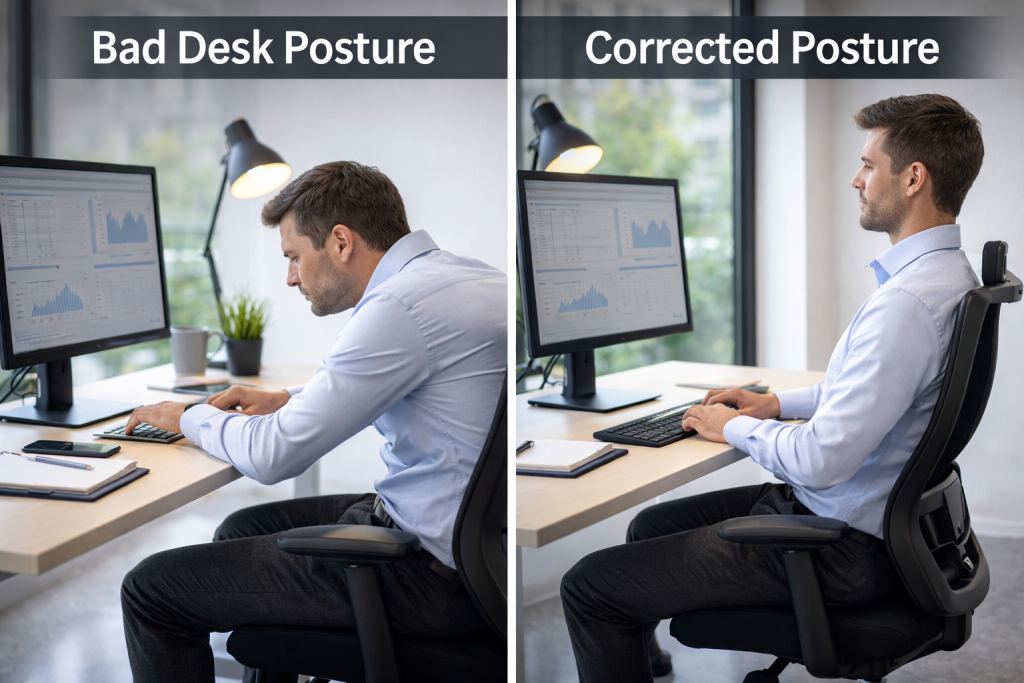
Chiropractic care does the heavy lifting when it comes to correcting structural issues, but what you do between appointments matters just as much.
The good news is that a few small changes to your daily desk habits can make a noticeable difference, starting today.
Set Up Your Chair and Screen Properly
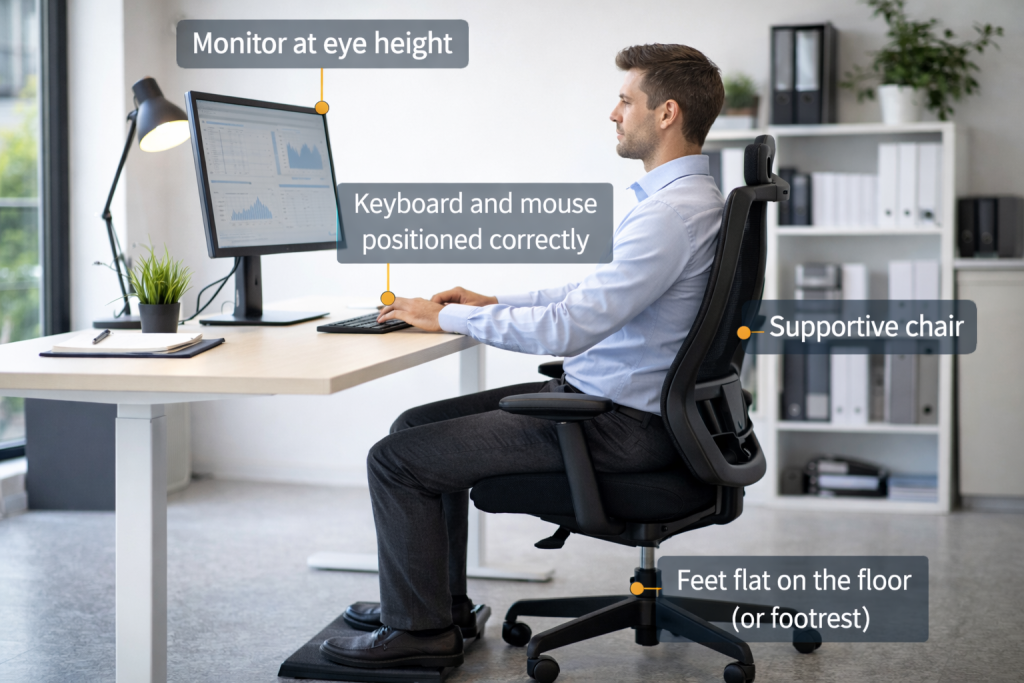
Your feet should be flat on the floor, not dangling or tucked under the chair. Position your screen so the top of the monitor sits at eye level, and keep your elbows bent at roughly 90 degrees when typing. These three adjustments alone take a surprising amount of strain off your lower back and neck.
Move Every 30 to 45 Minutes
Your spine does not care how perfectly you sit if you hold that position for three hours straight. Set a timer on your phone or use an app to remind you to stand, stretch, or take a short walk. Even 60 seconds of movement resets the muscles that tighten up from prolonged sitting.
Try Chin Tucks and Seated Thoracic Extensions
Chin tucks are simple: sit tall, gently pull your chin straight back (like you are giving yourself a double chin), hold for five seconds, and repeat five times.
For a seated thoracic extension, place your hands behind your head, gently lean back over the top of your chair, and hold for a few seconds.
Both exercises help counteract the forward slump that builds up throughout the day.
Rethink Your Work-From-Home Setup
If you are working from a kitchen table or a couch, your posture does not stand a chance. You do not need an expensive standing desk, but a proper chair with lumbar support, a separate keyboard, and a laptop stand or monitor riser make a real difference. Treat your home workspace with the same attention you would give an office setup.
How Often Should Office Workers See a Chiropractor?
For office workers dealing with active pain or stiffness, most chiropractors recommend starting with weekly visits for 4 to 6 weeks, then reassessing.
Once symptoms improve, many people shift to fortnightly or monthly maintenance visits to keep their spine mobile and prevent pain from returning.
The honest answer, though, is that it depends. Someone who has been sitting with poor posture for ten years will need a different plan than someone who started noticing tightness a few weeks ago.
How you sit, how often you move during the day, and whether you are doing your recommended exercises at home all play a role in how quickly your body responds.
That is why a one-size-fits-all schedule does not work. At Nook Chiropractic in Applecross, Dr Kyle Duncan builds personalised care plans around each patient’s work routine, symptoms, and goals.
Some people need more support early on. Others are ready to space out visits within a few weeks. The plan adjusts as you progress, not the other way around.
Key Takeaway
Sitting at a desk all day does not have to mean living with back pain, neck stiffness, or poor posture.
A chiropractor for office workers can pinpoint exactly what is going wrong, correct it, and give you the tools to stay pain-free long term.
If you are in Applecross or the greater Perth area and ready to sort out your desk posture problems, book an appointment with Dr Kyle Duncan at Nook Chiropractic.
You can schedule online with Dr. Kyle here.
Frequently Asked Questions
Perth chiropractic sessions typically run $70 to $130, with the first visit higher due to the assessment. Medicare doesn’t cover routine chiropractic, but most private health funds rebate part of the fee through extras cover. Check your limit and waiting periods first.
Many people feel relief within the first few sessions, though lasting change takes several weeks of consistent care plus home corrections. Pain built up over years takes longer to undo than recent tightness. Doing your stretches between visits speeds things up.
Usually yes, but tell your chiropractor about any disc issues, arthritis, osteoporosis, or past surgery first. A good practitioner adapts their technique, and may refer you for imaging or GP clearance if needed. Skipping that history is the real risk.
You can reduce a lot of strain through proper workstation setup, regular movement breaks, and core strengthening. Prevention works well before pain sets in. Once stiffness or recurring pain develops, self-help often isn’t enough to correct the alignment shifts already there.
Yes. Under WA work health and safety laws, employers must manage ergonomic risks at your desk. You can request a workstation assessment, an adjustable chair, or a monitor riser. Raise it with your manager or HR; body stressing is a recognised hazard.
Only if you alternate between sitting and standing. Standing rigid all day creates its own strain on your legs and lower back. The real fix is movement and position changes, so use a sit-stand desk to vary your posture, not replace one problem with another.
Tell your chiropractor if you’re not improving after a few weeks; the plan should change with your progress. They may adjust the approach, add rehab exercises, or refer you to a GP or physio to rule out other causes. Worsening pain always warrants a medical review.